BIMSA Develops “Yau–Yau Stochastic Network” Model, Breaking Noise Barriers for Precise Analysis of Complex Systems
Yau–Yau Stochastic Network
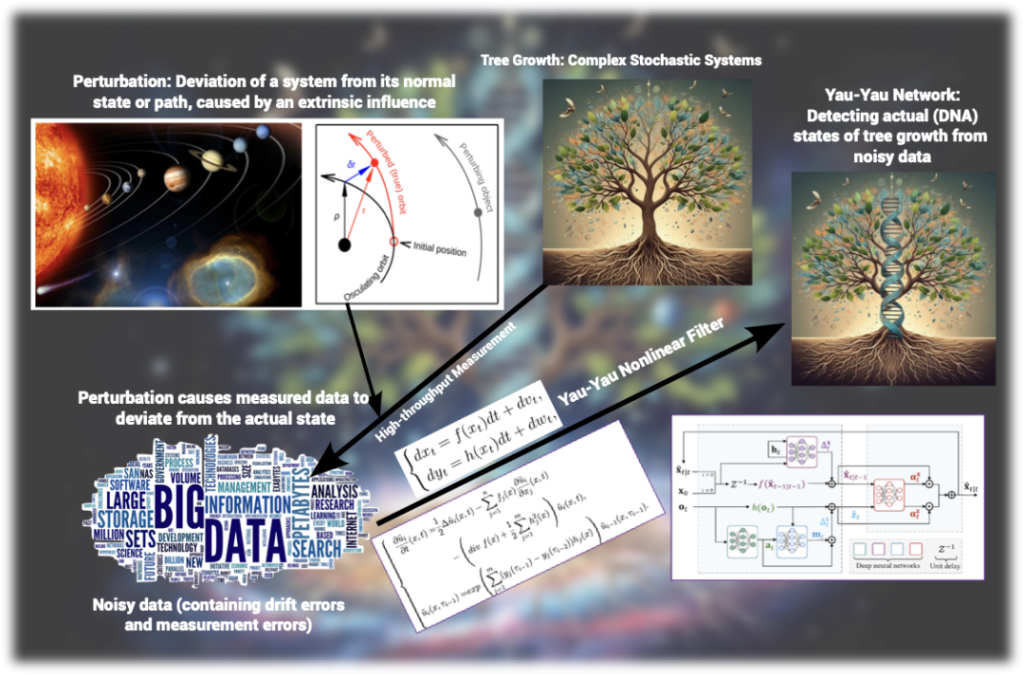
Recently, a research team led by Professor Rongling Wu at the Beijing Institute of Mathematical Sciences and Applications has achieved a major breakthrough in complex systems modeling. By integrating the Yau–Yau nonlinear filtering algorithm with stochastic network theory, the team developed a novel model—the Yau–Yau stochastic network—capable of reconstructing intrinsic interaction mechanisms from highly noisy and chaotic data.
The study, entitled “Statistical learning of stochastic complex systems via the Yau–Yau nonlinear filter,” has been published in the internationally renowned journal The Innovation (5-year IF = 40.2).
This work provides a powerful new mathematical framework for addressing complex system analysis across diverse fields, including life sciences, environmental ecology, and socio-economic systems. The first author is PhD student Shuyuan Xu (jointly trained by BIMSA and the Academy of Mathematics and Systems Science, Chinese Academy of Sciences), and the second author is PhD student Yu Wang (jointly trained by BIMSA and Renmin University of China). Professor Rongling Wu serves as the corresponding author. Assistant Researcher Ang Dong, and postdoctoral researchers Shuang Wu and Yu Wang contributed to the study. Professors Shing-Tung Yau and Chengdong Qiu, inventors of the Yau–Yau nonlinear filtering algorithm, provided critical guidance on the overall design and theoretical interpretation.
🧠 Research Background: Noise Challenges in Complex Systems
From microscopic cellular signaling and neural circuits to macroscopic ecological dynamics, financial market fluctuations, and celestial motion, real-world systems are characterized by nonlinearity, uncertainty, and strong noise interference. The interactions among system components evolve dynamically under stochastic fluctuations driven by both internal variability and external perturbations.
Traditional network modeling approaches are largely based on deterministic frameworks, focusing on average interactions or static topological structures. However, they struggle to capture and quantify intrinsic stochastic dynamics. Importantly, stochasticity is not merely background noise; it is often a fundamental mechanism underlying system resilience, adaptability, and robust regulation.
Therefore, developing new modeling frameworks capable of simultaneously capturing nonlinear interactions, intrinsic stochasticity, and external noise has become a critical challenge for understanding, predicting, and controlling complex systems.
🔬 Core Innovation: Reconstructing Stochastic Networks via Yau–Yau Filtering
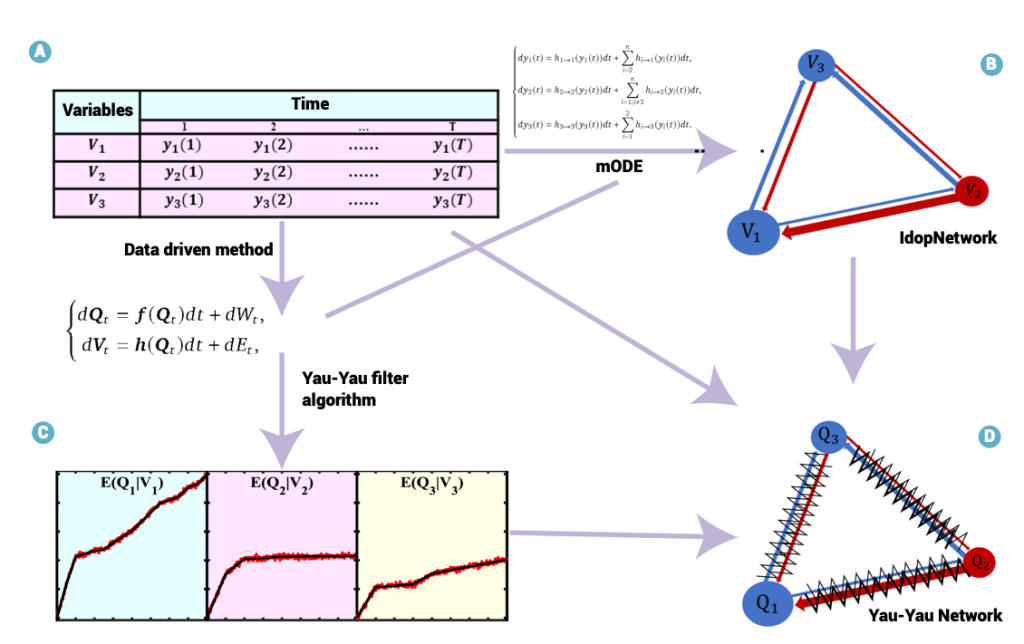
To address these challenges, the research team introduced the Yau–Yau nonlinear filtering algorithm—originally developed by Professors Yau and Qiu—into complex systems modeling. The algorithm transforms the Duncan–Mortensen–Zakai (DMZ) equation, which describes stochastic system evolution, into a forward Kolmogorov equation (FKE) that is more tractable for numerical computation.
Compared with classical Kalman filtering methods and their nonlinear variants (e.g., ensemble Kalman filter and unscented Kalman filter), the Yau–Yau algorithm demonstrates superior estimation accuracy and numerical stability, particularly in systems with strong nonlinearity, complex state spaces, and significant observational noise.
Building upon the IdopNetwork framework, the team developed the Yau–Yau stochastic network model, which enables a key advance: it dynamically and quantitatively reconstructs hidden interaction fluctuations among system components from noisy time-series data, providing a more realistic and fine-grained mathematical description of complex system dynamics.
🧪 System Validation: Simulation and Experimental Evidence
To rigorously evaluate the performance of the Yau–Yau stochastic network, the team conducted comprehensive validation studies.
In simulation experiments, multiple nonlinear stochastic systems with varying levels of complexity and noise were constructed. The results demonstrated strong performance of the Yau–Yau algorithm, particularly when applied to orthogonalized observational data.
In real-world validation, the researchers designed a microbial ecology experiment using three species—Escherichia coli, Staphylococcus aureus, and Pseudomonas aeruginosa—cultured in a controlled environment to form a simplified, observable ecosystem. By continuously monitoring species abundance dynamics, the team compared analyses based on traditional deterministic networks and the Yau–Yau stochastic network.
The results showed that traditional models could only capture static, average interaction relationships. In contrast, the Yau–Yau network successfully decoded stochastic fluctuations embedded in time-series data and translated them into dynamically evolving interaction strengths. This revealed how microbial communities adaptively adjust their interaction strategies in response to microenvironmental changes such as nutrient depletion and metabolite accumulation. These findings demonstrate the model’s strong analytical capability and practical potential in real biological systems.
🚀 Broad Applications and Future Directions
The Yau–Yau stochastic network provides a powerful and general framework for tackling key challenges across multiple frontier disciplines:
- Systems and synthetic biology: Decoding stochastic dynamics in gene regulatory, metabolic, and microbial networks
- Neuroscience and brain disorders: Inferring dynamic functional connectivity from noisy EEG and fMRI signals
- Environmental ecology and climate science: Modeling stochastic evolution of ecological networks under extreme environmental changes
- Finance and economics: Revealing hidden stochastic pathways of risk propagation and market dynamics
Looking ahead, the research team plans to further advance the framework by:
- Expanding applications to biomedical problems such as tumor microenvironments and host–microbiome interactions
- Developing higher-order stochastic interaction models to capture multi-node cooperative effects
- Integrating with GLMY theory and topological data analysis for deeper insights into structure–function relationships
- Extending the methodology to handle irregularly sampled or even static data, improving its practical applicability
🔗 Original Article

Copy the link into your browser or scan the QR code to access the full paper.