A Graph Statistical Model Reveals Gene Interaction Mechanisms During Plant Grafting
Grafting, an ancient agricultural practice, has been used by humans for thousands of years to improve crop yield, quality, and stress resistance. However, despite advances at the molecular level, how the “scion” (upper part) and “rootstock” (lower part) communicate genetically during grafting remains largely unresolved.
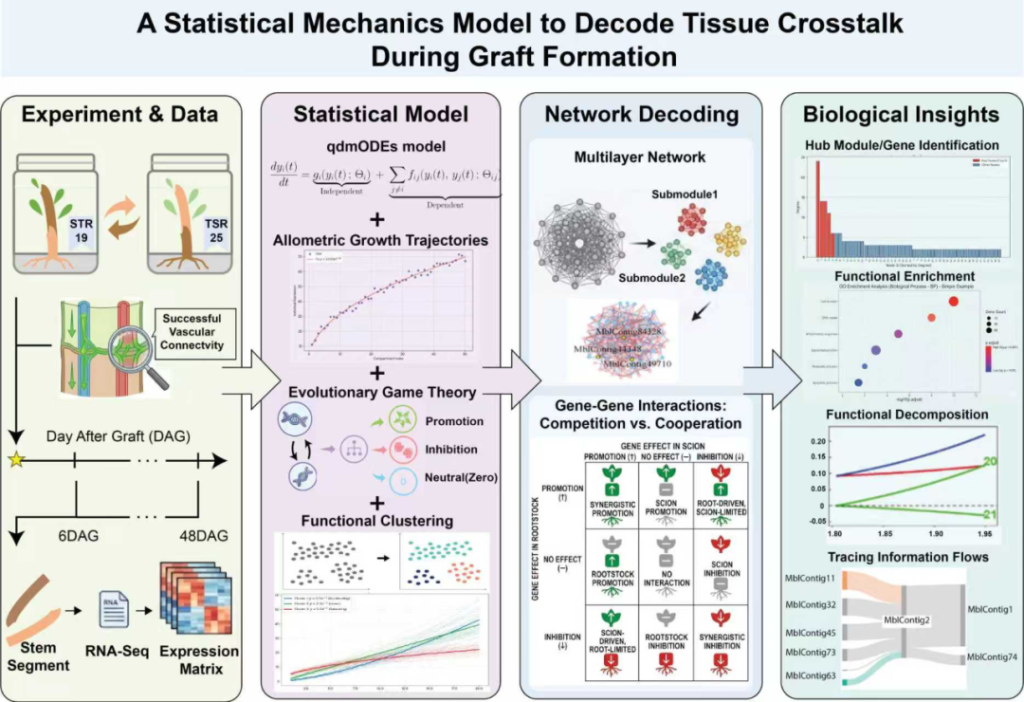
Recently, this long-standing challenge has seen a major breakthrough. A research team led by Professor Rongling Wu at the Beijing Institute of Mathematical Sciences and Applications has published a study entitled “A Statistical Mechanics Model to Decode Tissue Crosstalk During Graft Formation” in the interdisciplinary journal Advanced Science. The team developed a generalized statistical mechanics model that successfully decodes complex gene interaction mechanisms in grafted plants. This work not only reveals the molecular blueprint of plant healing and regeneration, but also provides a novel mathematical framework and theoretical perspective for plant science, evolutionary theory, and even human organ transplantation. The first author is Assistant Researcher Ang Dong, and the second author is PhD student Yihan Meng. Professors Chengdong Qiu and Shing-Tung Yau contributed to the mathematical theory of graph statistics underlying the model.
🧠 From “Individual Action” to “Strategic Interaction”
Successful plant grafting depends on precise coordination between the scion and rootstock during vascular reconnection. Traditional molecular biology studies have largely focused on identifying individual differentially expressed genes, making it difficult to capture the full system-level picture.
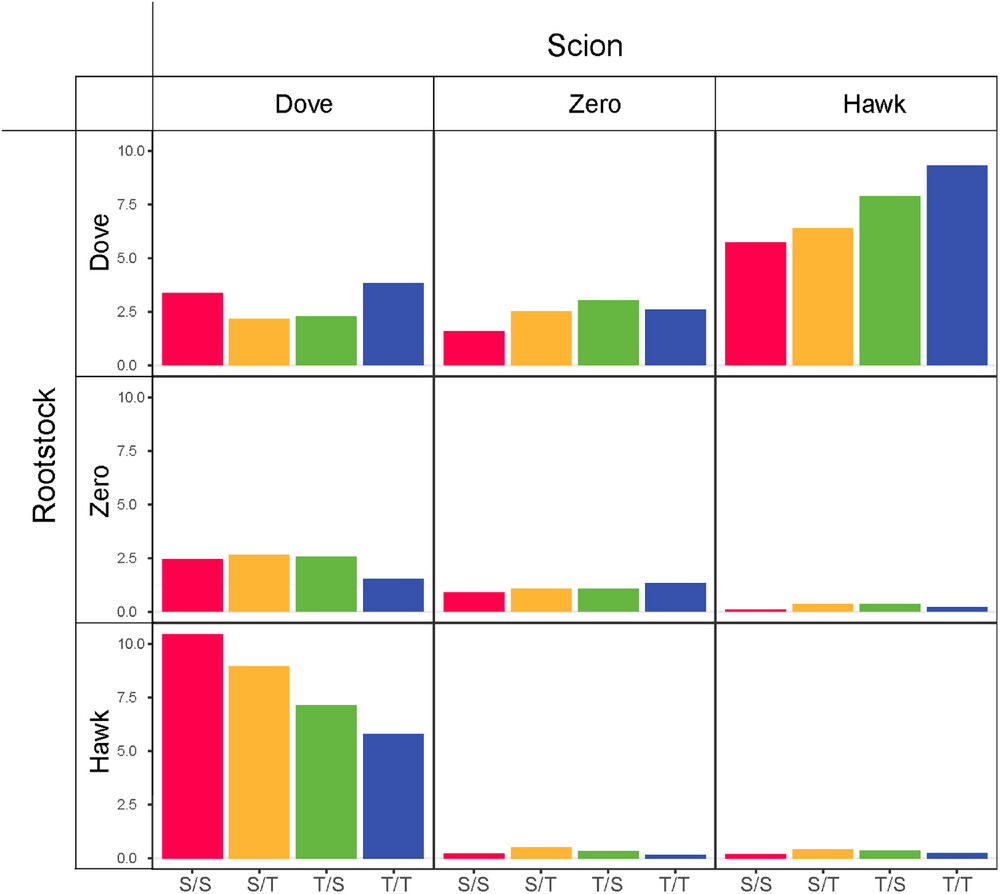
To overcome this limitation, the research team introduced tools from evolutionary game theory and complex network science into plant biology. By integrating directed graph topology theory, they developed a generalized statistical mechanics model that encodes thousands of interacting genes into an information-rich, dynamic, omnidirectional, and personalized network (idopNetworks). In this framework, the scion and rootstock are modeled as two players in a game, where gene-level strategies are quantified as “cooperation” (dove-like) or “competition” (hawk-like) to maximize overall growth.
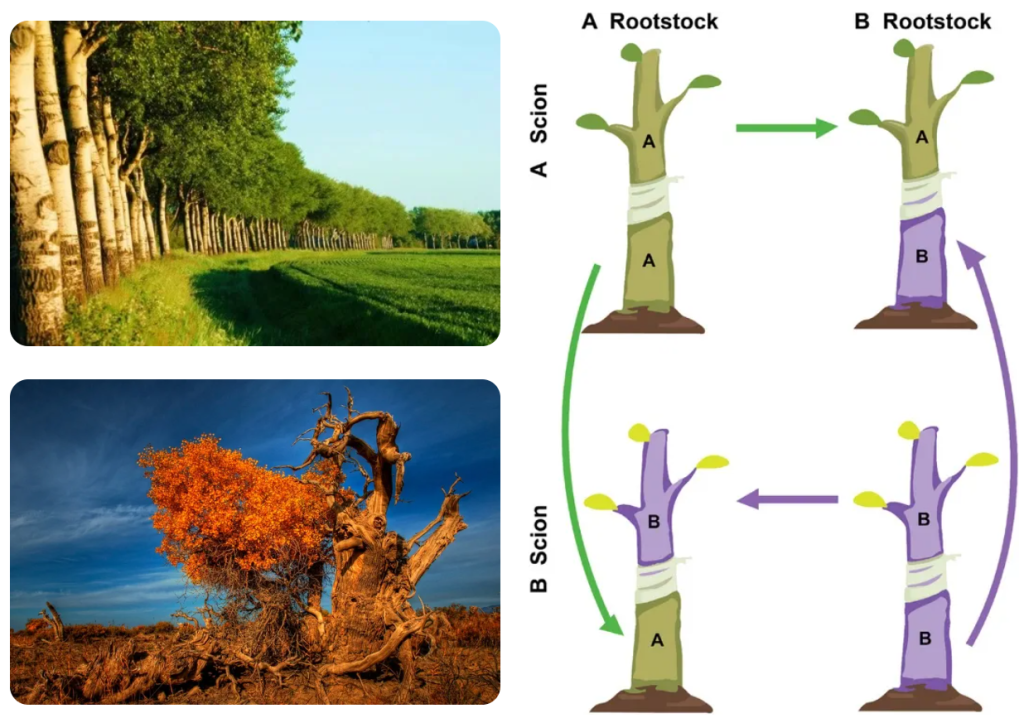
Figure 2. Grafting materials (left) and experimental design (right)
To validate the model, the researchers conducted a carefully designed experiment using two distantly related poplar species: Populus szechuanica var. tibetica (S) and Populus tomentosa (T). Through reciprocal micrografting and transcriptome sequencing, they analyzed gene expression dynamics during graft formation.
These two species are of high ecological and economic importance:
P. szechuanica var. tibetica is a key high-altitude species for water conservation and windbreaks, rich in stress-resistance genes
P. tomentosa is widely used in timber production, papermaking, and urban greening
The results showed:
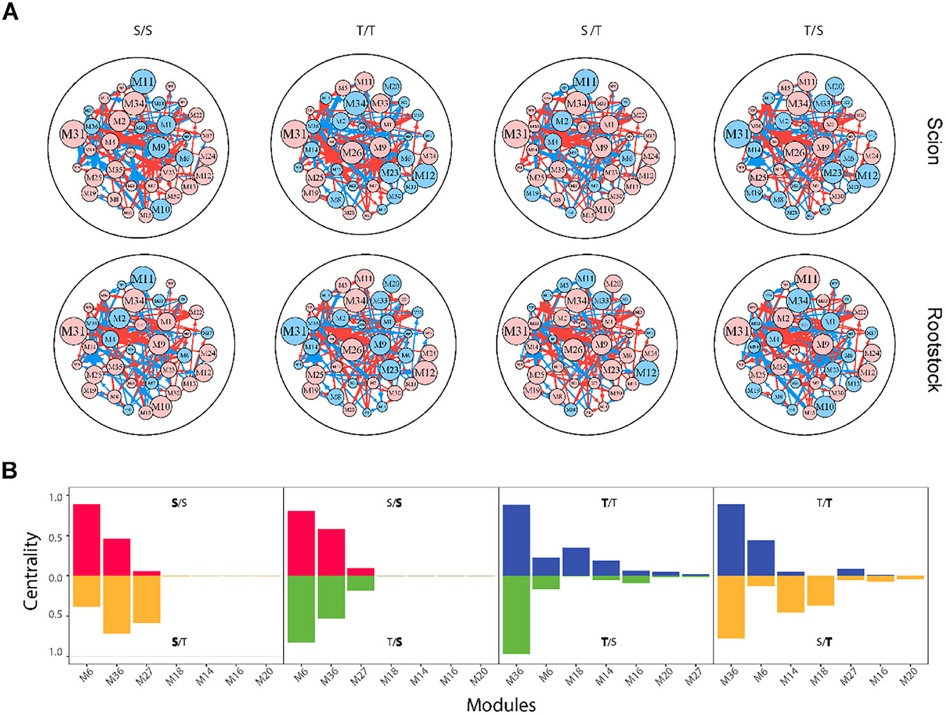
Greater fluctuations in interspecific grafting: Compared with intraspecific grafts, grafting between different species induced stronger gene expression fluctuations, resembling ecological disturbances caused by species invasion.
Cooperation outweighs conflict: Genes promoting cooperation between scion and rootstock far outnumber those associated with antagonistic interactions, explaining why certain graft combinations have higher survival rates.
Optimal pairing:P. szechuanica (S) demonstrated greater resilience. When P. tomentosa (T) was used as the scion and S as the rootstock, the gene interaction network exhibited more favorable survival patterns, providing guidance for species selection in forestry practice.
Identification of key hub genes: Genes such as MblContig84328 and MblContig44348 act as central regulators in vascular reconnection and signal transduction.
Figure 3. Inter-module networks and network metrics
🌍 Beyond Plant Biology
This study represents not only a breakthrough in plant science, but also a compelling example of interdisciplinary integration between applied mathematics and life sciences. The authors emphasize that the idopNetworks model provides a powerful computational framework that can be extended beyond horticulture.
“This generalized statistical mechanics model allows us to map how genes ‘communicate’ between scion and rootstock during healing,” said Professor Rongling Wu. “In the future, this framework may even help us understand compatibility and integration in human organ transplantation, offering cross-disciplinary insights into complex biological systems.”
Figure 4. Game-theoretic interactions between scion and rootstock during micrografting of poplar