
Major Breakthrough in Quantitative Genetics Achieved by BIMSA and Beijing Forestry University
Recently, a joint research team led by Professors Shing-Tung Yau and Rongling Wu from the Beijing Institute of Mathematical Sciences and Applications, together with Professor Lidan Sun’s group from Beijing Forestry University, has made a major breakthrough in the theoretical study of quantitative genetics. The research was published in the internationally renowned journal Proceedings of the National Academy of Sciences (PNAS) under the title “Graph statistics theory of individualized quantitative genetics under haplotype-resolved genome assembly.”
On April 9, 2026, BIMSA and Beijing Forestry University jointly held a symposium on “Intelligent Breeding” at Tsinghua University, where the breakthrough findings were presented. The meeting was attended by senior leaders and core research members from both institutions, and chaired by BIMSA Vice President Long Fei.

Figure 1. Scene from the “Intelligent Breeding” Research Symposium
🧠 New Theoretical Framework Proposed
Building on prior studies of genome-wide interaction networks, the research team integrates haplotype-resolved genome assembly with graph statistical methods to establish a novel framework for individualized quantitative genetics. This framework provides new theoretical support for:
- deciphering the genetic mechanisms of complex traits
- enabling multi-gene precise editing
- advancing personalized biological interventions
and marks the emergence of a new direction in quantitative genetics.
📜 A Century-Old Theory Continues to Evolve
Since its foundation by Ronald A. Fisher in the early 20th century, quantitative genetics has served as a cornerstone of modern breeding and complex trait research. Classical theory decomposes genetic variation into additive, dominance, and epistatic effects, and establishes analytical frameworks based on population-level statistics such as mean comparisons, variance analysis, and parameter estimation. Over the past century, this framework has played an indispensable role in crop breeding, animal improvement, QTL mapping, and genomic selection.
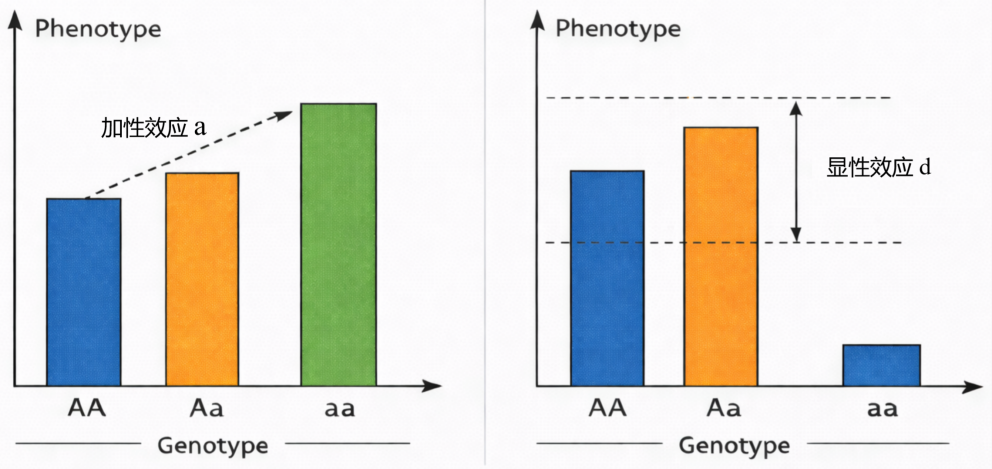
Figure 2. Illustration of additive and dominance effects in classical quantitative genetics
🔬 From Locus Association to Individual Mechanisms
With the advent of the genomic era, genome-wide association studies (GWAS) have identified numerous loci associated with complex traits at the population level. However, complex traits are typically governed by polygenic effects, pleiotropy, and extensive gene interactions within regulatory networks. As a result, statistical significance at individual loci often fails to reflect their true regulatory roles within specific individuals.
Although an increasing number of associated loci have been identified, key challenges remain, including limited interpretability of multi-gene regulatory mechanisms and unclear pathways for precise genetic intervention.
Understanding the genetic regulation of complex plant traits remains a central challenge in modern biology. As Professor Rongling Wu explains:
“It is like constructing a building—one must consider both the arrangement of each brick and the overall structural design. Seemingly simple gene combinations can produce effects far greater than the sum of their parts, a phenomenon known as emergence in complex systems.”
He further emphasized that traditional quantitative genetics faces limitations in resolving such intricate gene interactions. In the era of precision breeding and precision medicine, the field must transition from population-level statistical analysis to individual-level structural understanding.
🔗 Integrating Multidisciplinary Approaches
To address these challenges, the research team developed a new theoretical framework by combining haplotype-resolved genome assembly with graph statistical theory. In this framework:
- each individual genome is modeled as a genome-wide allele interaction network
- allele expression is decomposed into independent and interaction-dependent components
- individual-specific genetic structures are reconstructed using sparse modeling and network topology analysis
This approach enables a fundamental shift from population-based comparisons to mechanistic modeling at the individual level.

Figure 3. Professor Rongling Wu presenting the research findings
🧩 Reconstructing the Concept of Genetic Effects
Within the individualized quantitative genetics framework, classical genetic effects are reinterpreted:
- dominance is defined as bidirectional interactions between alleles at the same locus
- epistasis represents interactions between alleles at different loci, including both intra- and inter-haplotype interactions
- pleiotropy is modeled as cross-trait and cross-tissue network connections
Through this reconstruction, genetic effects are no longer abstract statistical quantities, but are represented as structured networks with directionality, strength, and sign, enabling a more precise characterization of genetic mechanisms.
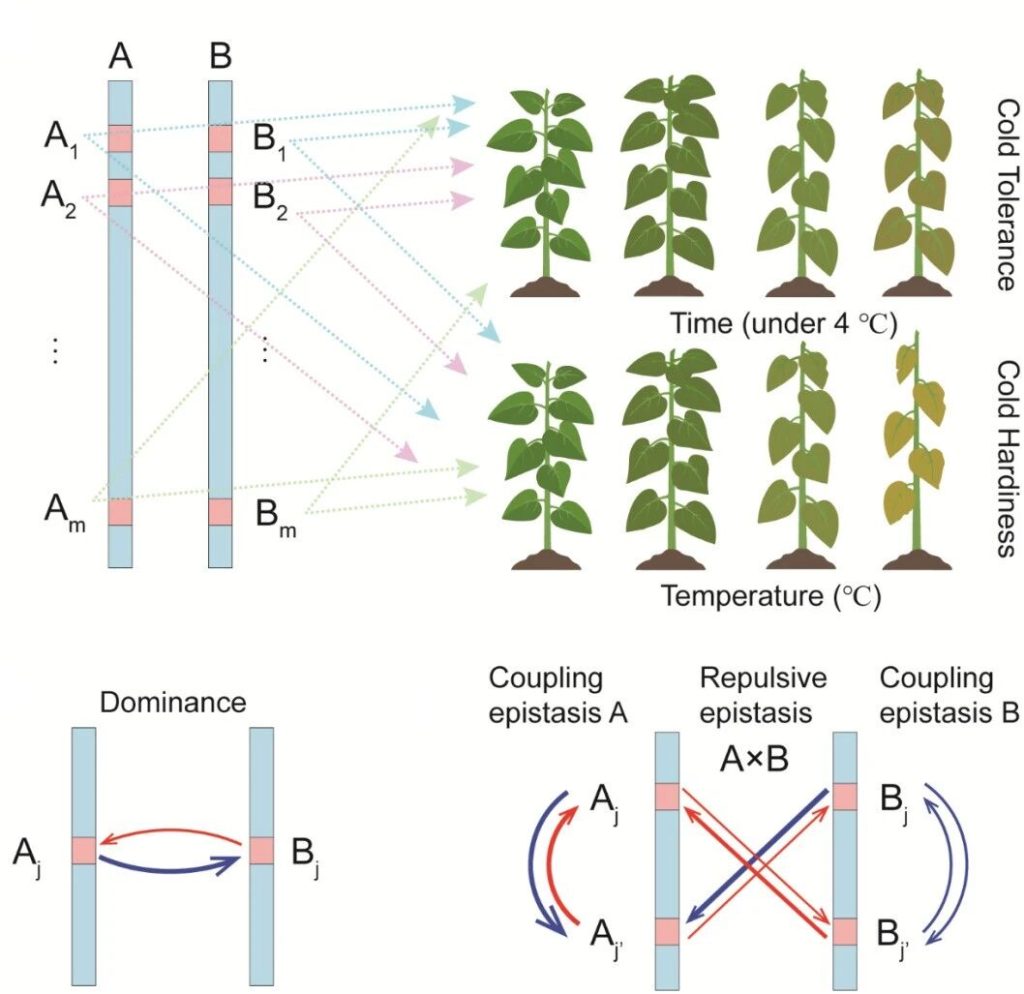
Figure 4. Dominance and epistatic interactions in individualized quantitative genetics
🌸 Validation in Prunus mume
The framework was validated using Prunus mume, a key ornamental and economic tree species in China. The research team constructed a haplotype-resolved genome and integrated transcriptomic data across multiple time points and organs to analyze the spatiotemporal dynamics of allele expression.
Using the proposed graph-based model, genome-wide alleles were integrated into an individual-level interaction network, revealing:
- genome-wide interaction patterns among alleles
- coordinated regulation across organs and developmental stages
- genetic mechanisms underlying cold resistance in Prunus mume
This work demonstrates the capability of the framework to uncover complex regulatory systems at the individual level.
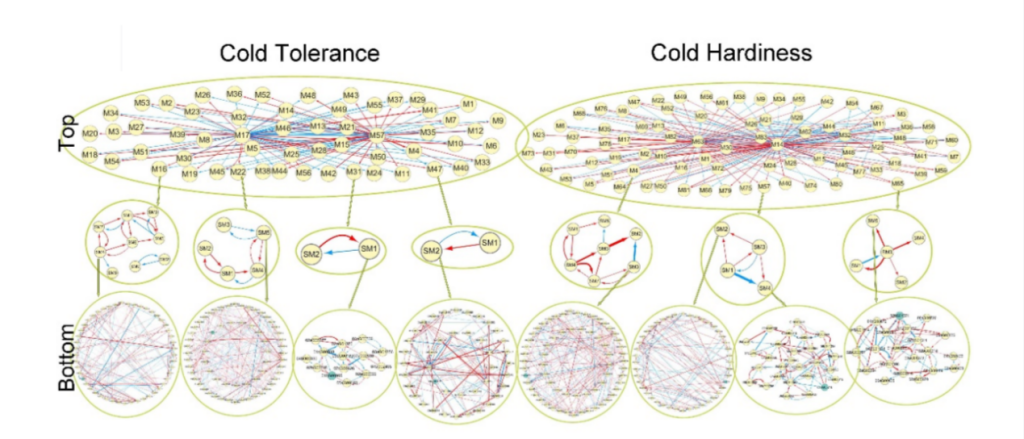
Figure 5. Allelic epistatic interaction network in individualized quantitative genetics
🚀 Toward Practical Applications
Professor Wu noted:
“In genetics, improving one trait often comes at the expense of another. By modeling gene interaction networks, we can uncover the ‘instruction manual’ of genetic regulation and precisely control specific traits.”
The team is currently collaborating with leading medical institutions, including Peking Union Medical College Hospital and Tiantan Hospital, to explore applications in Alzheimer’s disease, aging, and imaging-based therapies.
🌍 International Recognition
The concept of individualized quantitative genetics has received strong recognition from the global scientific community. Scott V. Edwards, a member of the U.S. National Academy of Sciences and professor at Harvard University, commented:
“This theory provides a new perspective for quantitative genetics, enabling the construction of interpretable genetic architectures at the individual level. It is expected to advance research toward gene interaction and systems-level regulation, offering a foundation for precise analysis and control of complex traits.”
🔗 Original Article
Scan the QR code or visit:
https://www.pnas.org/doi/abs/10.1073/pnas.2600004123?af=R