Training Workshop on “idopNetwork and Complex Biological Systems Analysis” Successfully Held at Beijing Forestry University
From May 16 to 17, 2026, the training workshop entitled “idopNetwork and Complex Biological Systems Analysis”, jointly organized by the Beijing Institute of Mathematical Sciences and Applications (BIMSA) and Beijing Forestry University (BFU), was successfully held at Beijing Forestry University. Nearly 200 faculty members, students, and researchers from diverse disciplines, including biology, mathematics, computer science, ecology, grassland science, and landscape architecture, participated in the event.
During the opening ceremony, university leaders from Beijing Forestry University, together with representatives from the School of Grassland Science, the School of Landscape Architecture, and the Office of Science and Technology, delivered welcoming remarks. They emphasized the importance of strengthening interdisciplinary collaboration between mathematics and life sciences and promoting innovative applications of complex systems theory in biological research.
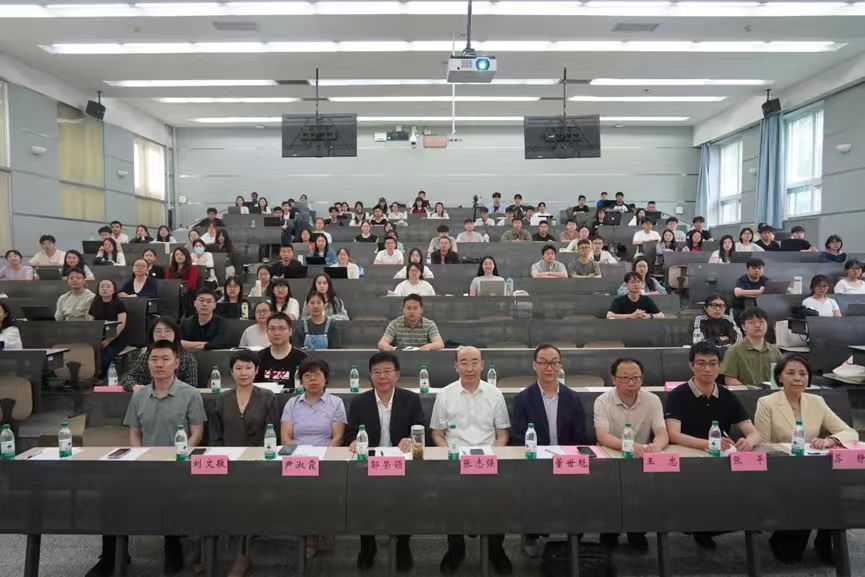
The workshop focused on cutting-edge topics in dynamic biological system analysis and network modeling, providing a comprehensive introduction to the theoretical foundations, computational algorithms, and practical applications of the idopNetwork framework across multiple biological disciplines.
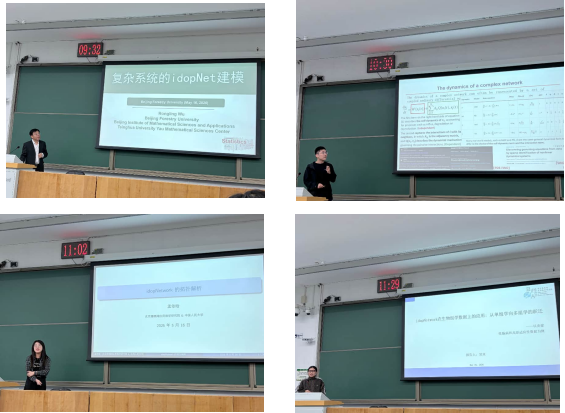
In the academic session, Professor Rongling Wu from BIMSA delivered a keynote lecture entitled “idopNetwork Modeling of Complex Systems”. He systematically introduced the development, theoretical framework, and scientific significance of the idopNetwork methodology for studying complex biological systems. Subsequently, Dr. Ang Dong presented network-solving approaches within the idopNetwork framework, Meng Yihan introduced methods for network topology analysis, and Dr. Shuang Wu demonstrated the application of metabolic idopNetwork to studies of human intestinal inflammation.
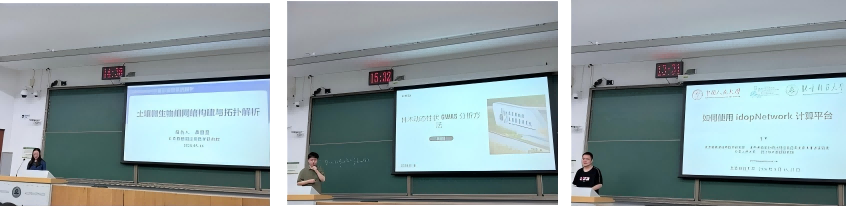
In the applied research session, Dr. Huiying Gong shared her work on soil microbiome analysis using idopNetwork, while Dr. Dengcheng Yang presented innovative applications of idopNetwork in forest tree genome-wide association studies (GWAS). In addition, Yu Wang provided hands-on demonstrations of the idopNetwork software platform, guiding participants through practical workflows and data analysis procedures.
The second day of the workshop focused on emerging technologies and integrated applications. Dr. Ye Tao, CEO of Ling’en Biotechnology Co., Ltd., introduced recent advances and future prospects in plant and animal genome assembly technologies. Professor Rongling Wu delivered a specialized lecture on Personalized Quantitative Genetics, highlighting recent developments at the intersection of network modeling and statistical genetics. Researcher Zhong Wang presented recent progress in virtual cell research driven jointly by mathematics and artificial intelligence.
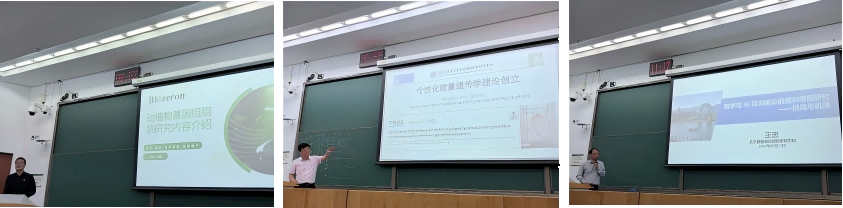
The interactive discussion session provided participants with opportunities to engage directly with experts on a wide range of topics, including soil microbiomes, grassland ecosystems, spatial omics, and GWAS. The discussions were highly interactive and fostered lively academic exchanges among attendees.
As biological research enters the era of big data, biological systems increasingly exhibit multi-component, nonlinear, and multi-scale characteristics. Traditional static analytical approaches are often insufficient to reveal their underlying dynamic mechanisms. Developed by Professor Rongling Wu’s research team, the idopNetwork framework integrates concepts from evolutionary game theory, functional clustering, and niche theory to characterize dynamic interactions within complex systems. The method has demonstrated broad application potential in genomics, ecology, medicine, and related fields.
The successful organization of this workshop provided an important platform for interdisciplinary learning and collaboration, further promoting the integration of complex systems theory with life science research. Looking ahead, BIMSA will continue to leverage its interdisciplinary strengths to advance collaborations among mathematics, life sciences, and artificial intelligence, contributing new theories and methodologies for the analysis and prediction of complex biological systems.